How to Automate Your Business When You're Buried in Admin Tasks (10 Signs You're Ready)
You know that feeling when your to-do list keeps growing… and growing… and somehow grows again overnight? You open your laptop and - boom - you’re already behind before you log in.
It’s kind of like getting tossed onto NHL ice mid-play: players flying past, the crowd roaring, everything happening faster than you can process… and you’re just trying to stay on your feet.
And the cost?
Your time, your focus, your energy - maybe even your revenue - slipping through the cracks because admin isn’t optional; it’s unavoidable. But here’s the twist: learning how to automate your business isn’t about becoming a tech wizard; it’s about freeing up time so you can get back to work that actually earns money, fuels you creatively, and lets you breathe again.
If that sounds like relief, just you wait.
What “Automating Your Business Really Means
Before we jump into the signs, let’s clear up a myth. Automation isn’t cold, robotic, or impersonal - it’s intentional. When done right, it’s simply creating systems that support you while you’re doing everything else - working, resting, or doing your yearly Gilmore Girls rewatch.
So, you don't need to stress about automation making you seem robotic. Automation creates the opposite: clarity, consistency, and calm.
10 Signs You’re Ready to Automate Your Business
1. You’re sending the same emails over…and over…and over
At this point, your hands could write these emails without you; they’ve been at it for so long.
Cost: lost time you could spend on working on client deliverables or pitching new projects.
Benefit: Automate once; communicate flawlessly every time. (Spend 2 minutes or less on client emails every time.)
2. You’re delaying invoices because the process is clunky
A client said it best in a LinkedIn post:
“I spent an entire hour doing invoicing, and it did not make me feel energized, inspired, or ready to do my best work.” This is where I came in to help automate this process — you should feel GOOD about sending off those payment requests.
Cost: real revenue leakage; hours of focus you’ll never get back, and the kind of energy drain that stalls your momentum before the day even begins.
Benefit: automated invoicing means faster payments, cleaner books, and fewer money-related headaches.
3. Your inbox looks like Monica’s closet
Is it just me, or are you treating your inbox like a secret junk closet that you’re embarrassed of?
You have no idea what you’ve replied to, what you haven’t, and you’re missing essential client emails, leaving you looking like a slacker. (And you aren’t one, you’re just overwhelmed.)
Cost: missed opportunities, slower replies, and an overwhelmed brain that can’t prioritize anything because everything feels urgent.
Benefit: an inbox you aren’t scared to open + clients that feel taken care of
4. Scheduling feels like a ping-pong match - except no one is keeping score and everyone is losing.
“Does Tuesday work?”
“No, what about Wednesday?”
“Actually, I’m booked…how’s next week?
Cost: all that back-and-forth steals time, slows your momentum, and makes it way too easy to double-book yourself because you swore you told someone that time was taken…but your calendar (and brain) are saying otherwise.
Benefit: you get to send out a scheduling link that keeps track of your availability for you - goodbye back and forth!
5. You’re gathering the same client info manually every time
Forms exist for a reason. Automated intake eliminates back-and-forth communication, providing clients with a smooth and confident first impression.
Cost: onboarding friction; slowed momentum; constant back-and-forth; longer kick-off calls
Benefit: You get what you need without spending precious time attempting to get responses from clients.
6. Tasks fall through the cracks because nothing triggers automatically
If you rely on your memory alone, you’re already overloaded.
I LOVE a planner (seriously, I also design planner sticker kits), but you cannot run a business fully with a planner alone. You need some sort of project management tool or system, and if you can automate repetitive tasks, it frees up your brain to remember the other things you need to do.
Cost: tasks falling through the cracks, constantly feeling like you’re playing catch-up, and remembering things you were supposed to do in the middle of the night
Benefit: trusting that your to-do list has you covered and nothing is going to be forgotten
7. You spend more time providing updates than doing actual work
What did you actually do for your clients this week? Do you even remember? Or do you need to dig back through your planner? Do you find yourself skipping sending out status updates because it just feels like too much?
Status updates are one of the easiest ways to automate your business without lifting a finger. You can start sending off updates each week to your clients without a ton of energy spent, and they’ll stop sending you “how are things going?” emails that take up space in your inbox and brain.
Cost: wasted admin time, context switching, and frustration.
Benefit: clients feel taken care of, and you don’t have to spend hours each week sending off updates
8. You avoid checking metrics because pulling reports is painful
If gathering data takes forever, you won’t do it. And if you don’t have data, you can’t make any improvements. The bottom line? You can’t run a business without knowing what is working and what isn’t. And the only way to know is to keep track of your metrics.
Cost: flying blind, missed opportunities, no insight into what’s working.
Benefit: automated dashboards show performance instantly and help make smart business decisions
9. You’re holding everything together with mental notes
Sticky notes, random docs, reminders in 14 places - including that one sticky note that lost its stick last week.
Relying on this system is going to get you nowhere, fast. Because when your desk (and virtual space) is a mess, your brain feels like a mess. Clean it all up by setting up a space to track what you’re working on, and automations that help you carry it all out.
Cost: constant mental strain, no true rest, and burnout
Benefit: let your systems carry the load so your brain doesn’t have to look at chaos around you
10. You’re considering hiring someone just to handle repetitive tasks
I’m all for hiring help. But, before you hire, automate.
Otherwise, you’re paying a human to click buttons and send reminders that a system could handle for you.
Instead, save your money so you can hire for strategy and skill, not for the repetitive admin tasks that automation can do faster and more accurately.
Cost: overspending on labor; unnecessary team growth.
Benefit: automation could clear 5 - 10 hours/week before you ever bring in help.
So…How Do You Actually Start Automating Your Business?
Now that you know how to automate, let’s make it gentle, approachable, and doable.
Step 1: Identify the biggest bottlenecks
Think about the tasks that make you sigh out loud - things like chasing down client info, sending the same email for the tenth time, or manually moving tasks between boards. (Which of the 10 above made you feel just a little too seen?)
Step 2: Start with simple automations that save the most time
For most service providers, this looks like: automated invoices, form-based intake, booking links, or “if this, then that” task assignments.
Step 3: Build one automation per week. Don’t expect perfection. Start basic so that you can ….
Step 4: Keep optimizing once the foundations run smoothly.
Think of it like leveling up — each small system you build gives you more time, more clarity, and way less chaos. When you start small and then add on what you actually need, you’re going to be able to easily automate your business without feeling overwhelmed. Plus, it’s a lot simpler to add what you need than to build the “perfect” or “ideal” system and have to dismantle it.
You deserve a business that runs smoother, a calendar that feels lighter, a day that doesn’t vanish under admin tasks. And that starts with knowing what to automate first.
Get clarity, save time, reduce stress - then grab the systems that make it happen.
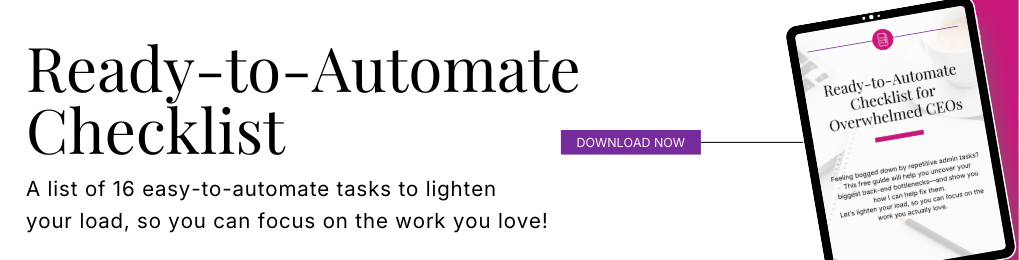
Which is why I created my Ready to Automate Checklist. So you can get started without the overwhelm!
Download your Ready to Automate Checklist to instantly see:
Where your most significant time leaks actually are
Which tasks are most manageable to automate
The exact systems that reduce your stress the fastest
The tools that make automation simple (and not scary)
Grab your checklist → subscribepage.io/UoYVpg
If you’re reading this and thinking, “Okay…this all sounds great, but I don’t have the time to do this myself,” you’re not alone - and you definitely don’t have to figure this out by yourself.
Sometimes the easiest way to automate your business is to have someone in your corner who can untangle the messy parts, break things down, and map out what actually matters.
If you want someone else to build out systems that will support you and create clarity, I’d love to help. Let's chat and make this feel lighter.